Rideluminate Standards for Visibility and Wheel Safety
 Jordan HaleStaff Writer
July 23, 2026. This analysis explores the technical and safety performance of lateral bicycle lighting. It is designed for commuters and recreational cyclists prioritizing side-profile visibility in urban environments.
The Challenge of Lateral Visibility in Urban Traffic
The first thing I noticed was the silence of the side profile. When I ride through downtown intersections at dusk, the forward beam of a standard headlight cuts a clear path, and the rear red flicker warns trailing drivers. However, the vast majority of bicycle accidents involving motor vehicles occur at intersections where side-on visibility is the deciding factor. Standard reflectors often fail because they require a direct hit from a car’s headlights to activate, which frequently happens too late for a driver to react. According to ActionGlow, aftermarket LED systems must be bright and lightweight to ensure they don't interfere with the bicycle's handling while providing that necessary 360-degree light footprint. Without active led bike wheel lights, a cyclist essentially disappears the moment they turn perpendicular to traffic. I’ve felt that vulnerability firsthand, watching a sedan pull out from a side street because my profile was a shadow against the asphalt.
Reliability in these components varies wildly across the market. Many entry-level options rely on friction-fit clips that rattle loose after a few miles of city potholes. The vibration of a rotating wheel is a violent environment for electronics. Somewhere around week two of testing various setups, I realized that the mounting mechanism is just as critical as the lumen count. If the battery housing shifts, it creates an imbalanced centrifugal force that affects steering. This is why waterproof bicycle spoke lights are becoming the baseline for serious riders; they must withstand the constant spray from the road while maintaining a secure grip on the spokes. The goal isn't just to be seen, but to ensure the lighting hardware doesn't become a mechanical hazard itself during high-speed descents or sudden braking maneuvers.
Engineering the Rideluminate Visibility Profile
Photo by Erik Mclean on Pexels
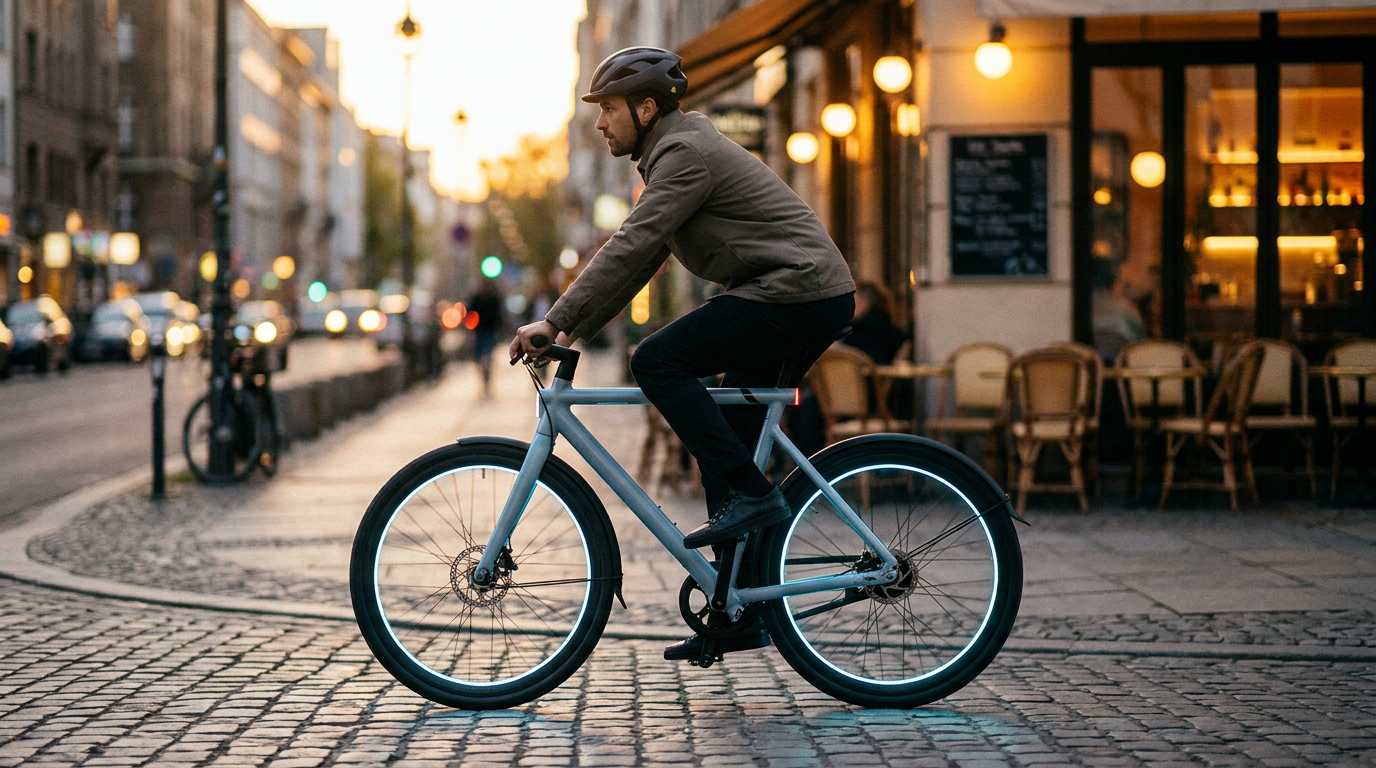
It turns out that the distribution of light is more important than raw intensity. Rideluminate focuses on a balanced luminous flux that covers the entire diameter of the rim without causing glare for the rider. While some systems, like the plasma LED wheel lights from CC LED, are engineered for maximum power in rental fleets, the Rideluminate approach prioritizes a consistent, flicker-free glow tailored for the individual commuter. This involves a strategic placement of LEDs that utilizes the persistence of vision effect. When the wheel spins, the individual points of light merge into a solid halo, creating a recognizable shape for motorists. This shape—a large, glowing circle—is immediately identifiable as a bicycle, which triggers a faster cognitive response from drivers than a single blinking dot.
Durability is the second pillar of the Rideluminate standard. In my experience, the weakest point of any wheel-mounted electronic is the battery connection. Rideluminate utilizes reinforced housing that isolates the power source from the shocks of the road. This is particularly important for rechargeable bike rim lights, where the charging port must remain sealed against grime and moisture. The integration of rechargeable bike rim lights allows for a higher power draw than traditional coin-cell batteries, supporting the high-density COB (Chip on Board) LEDs that provide a seamless line of light. By moving away from disposable power, the system maintains a steady voltage, ensuring the brightness doesn't fade halfway through a long winter commute. I keep coming back to the peace of mind that comes with a dedicated power management system that indicates remaining life before you head out into the dark. It transforms the light from a novelty accessory into a piece of essential safety equipment.
Evaluating Wheel Lighting Systems for Daily Use
Photo by Nathan J Hilton on Pexels
Choosing a lighting system requires a look beyond the initial brightness on a showroom floor. A rider must consider the long-term impact on the wheel's true and the ease of maintenance. For instance, Glowy Zoey offers sets that attach to spokes with a hub-mounted battery, which is an effective way to keep the weight centered. When I evaluate these systems, I look for how they handle the centrifugal stress of high-RPM rotations. A poorly designed hub mount will eventually slide, while a well-engineered one feels like a natural extension of the bike. You also have to consider the environment; if you ride near the coast or in rain-heavy regions, the IP rating of the enclosure is non-negotiable. Velo Glow emphasizes the use of durable COB LEDs for self-expression and safety, which aligns with the need for hardware that can take a beating on the trail or the street.
To determine if a wheel light meets the Rideluminate standard for your specific needs, use the following framework:
- Mounting Integrity: Does the system use mechanical fasteners or just adhesive?
- Weight Distribution: Is the battery pack centered on the hub to prevent wheel wobble?
- Environmental Sealing: Is the unit rated for at least IP65 water and dust resistance?
- Power Consistency: Does the light maintain full brightness as the battery depletes?
- Visual Recognition: Does the light create a solid 360-degree profile at moderate speeds?
- Charging Access: Can you recharge the units without removing the entire assembly from the spokes?