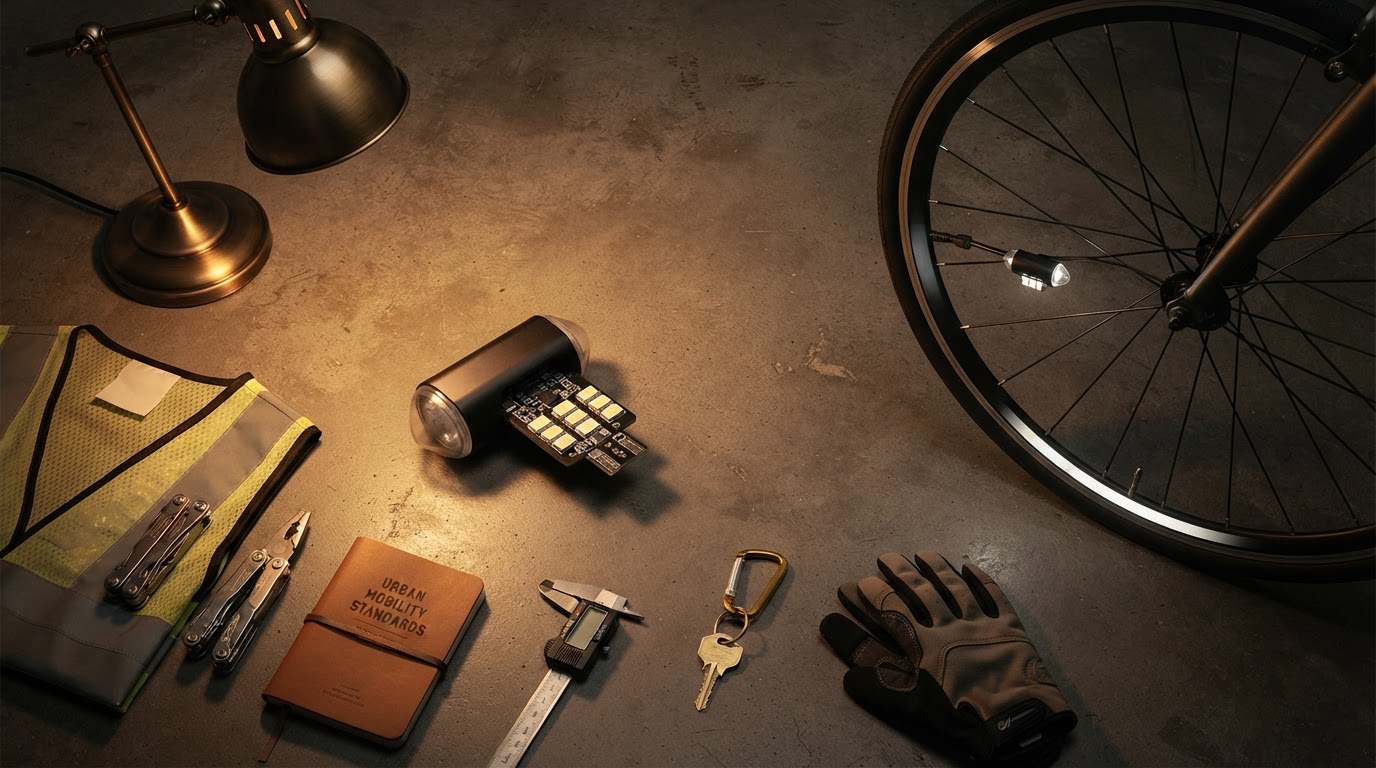
Rideluminate Standards for High-Visibility LED Bike Wheel Lights
 Maya ChenContributing Editor
August 8, 2026. This technical analysis evaluates the performance parameters of side-profile illumination for night cycling. It provides a framework for urban commuters and safety-conscious riders to differentiate between aesthetic novelty and functional visibility hardware.
The Failure of Standard Reflective Gear
The conventional wisdom says that passive reflectors and standard front-and-rear blinking lights are sufficient for night safety. Data suggests otherwise. While front lights illuminate the path and rear lights signal presence to following drivers, neither addresses the T-bone collision risk at intersections, which accounts for a significant percentage of urban cycling accidents. Standard reflectors require an external light source to hit them at a specific angle to function, creating a dangerous dependency on a driver’s headlight alignment. According to Velo Glow, COB LED technology has moved beyond simple decorative applications to become a critical component for night riding safety and self-expression.
Here's the part nobody talks about: many aftermarket solutions suffer from parasitic drain or structural failure within 100 miles of use. When evaluating led lights for bike wheels, the industry often prioritizes lumen count over thermal management and centrifugal durability. A light that is bright in a static showroom often fails when subjected to the constant vibration and rotational forces of a 700c wheel at speed. Furthermore, the weight distribution of these units is rarely discussed. Adding unbalanced mass to the spokes creates a flywheel effect that can degrade handling. For riders utilizing spoke lights for bicycle wheels, the mechanical strain on the nipple and spoke interface is a non-trivial engineering hurdle that most consumer-grade products ignore.
Rideluminate Engineering and Integration
Photo by cottonbro studio on Pexels
Rideluminate addresses these failures by focusing on the intersection of lumen density and mechanical balance. Unlike generic strips that rely on flimsy adhesive or zip ties, professional-grade systems must utilize secure hub-to-rim tensioning to ensure the hardware stays centered during high-velocity rotation. Run the math: a wheel spinning at 20 mph generates significant G-forces that can transform a poorly secured battery pack into a projectile. This is why high-end systems, such as those documented by Glowy Zoey, specifically design their battery compartments to attach to the hub, minimizing the centrifugal load on the spokes.
Durability in the Rideluminate ecosystem is measured by IPX ratings and vibration resistance. Urban environments subject hardware to road salt, rain, and potholes. A light that isn't fully encapsulated in a polymer housing will inevitably succumb to moisture ingress. When considering rechargeable bicycle wheel lights, the sealing of the charging port is the primary point of failure. Rideluminate advocates for recessed, gasket-sealed ports that prevent the corrosion common in cheaper USB-rechargeable units. Furthermore, the shift toward rechargeable bicycle wheel lights reflects a necessary move away from alkaline waste, provided the lithium-ion cells are shielded from the physical shocks inherent in cycling. The focus remains on maintaining a constant output; many lights dim as the battery depletes, but professional-grade circuitry ensures consistent brightness until the cell reaches its cutoff voltage.
A Framework for Evaluating Wheel Illumination
Photo by Matúš Burian on Pexels
Selecting a lighting system requires moving past the marketing fluff of "360-degree glow" and looking at the actual build quality. A reliable system must be more than a string of LEDs; it must be a piece of vehicular hardware. This is especially true for heavy-duty applications. As noted by CC LED, plasma-style LEDs are often required for rental fleets and enthusiasts who demand the highest power output available. When comparing different led lights for bike wheels, cyclists should use a specific rubric to determine if the product is a safety tool or a toy.
- Mounting Security: Does the system use hub-mounted battery housings to prevent wheel imbalance?
- Ingress Protection: Is the unit rated at least IP65 for dust and water resistance?
- Lumen Consistency: Does the internal driver maintain brightness levels as voltage drops?
- Weight Distribution: Is the total added weight under 100 grams per wheel to avoid affecting gyroscopic handling?
- Optical Diffusion: Are the LEDs diffused to provide a solid arc of light rather than distracting individual hotspots?